



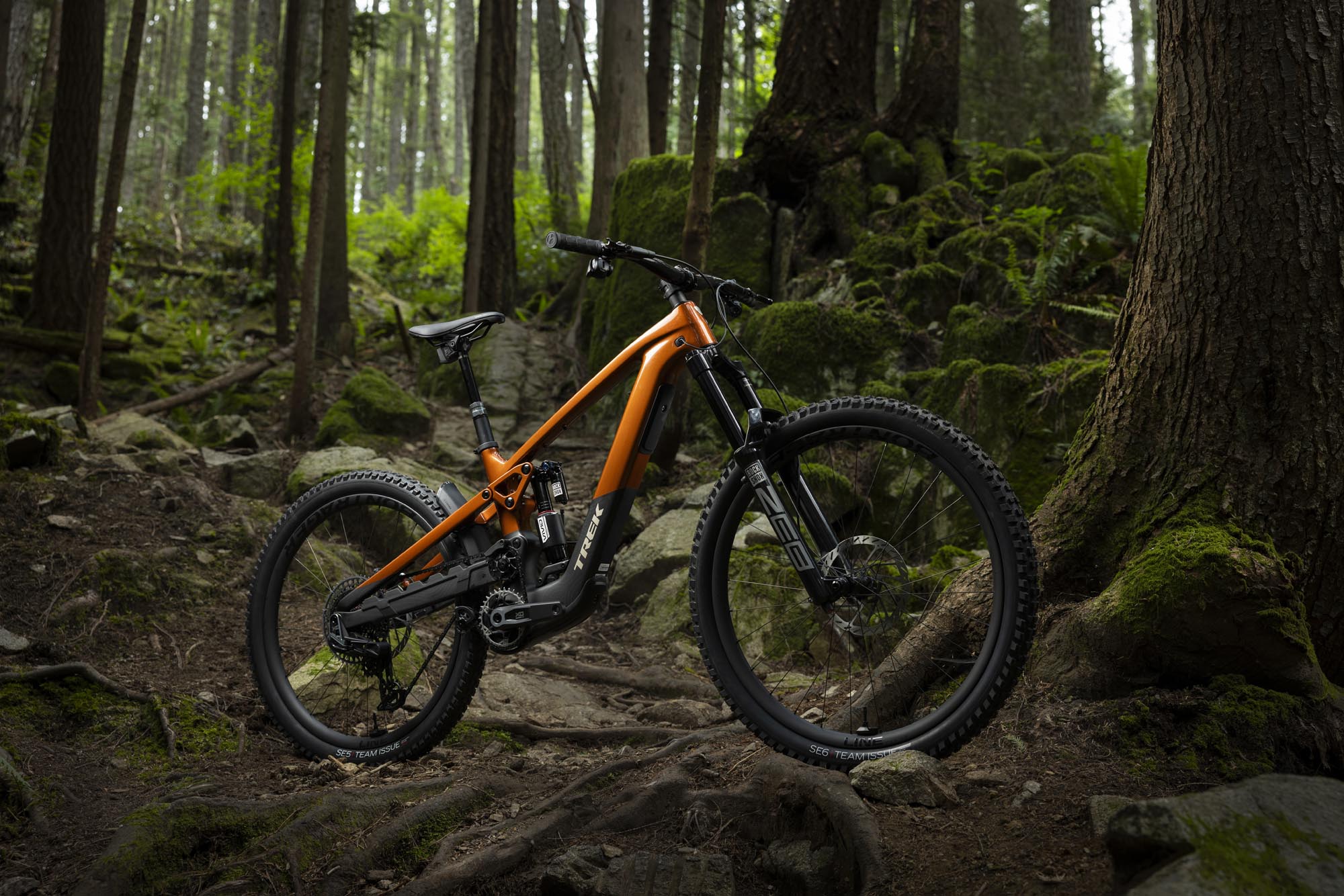
The Trek Slash+ proved to be one of the best handling long travel e-Bike’s that we have ever tested here at the mag. It’s stunning trail performance is due to an incredible cleverly designed lightweight frame that boasts 170mm of travel at each end, which is neatly coupled with a high pivot and idler combo, which sits alongside the remarkably smooth pedalling and quiet TQ Industries motor.
There is no denying that the Slash+ is a masterpiece, but how did Trek pull it all off? In a quest to find out [R]evolution scored unprecedented behind the scenes ‘direct’ access to the team at Trek that brought this bike to life. Ever wondered about how an industry leading e-MTB is developed? Strap in because you’re about to find out!

Maddie Spurlock – Slash+ frame engineer
As one of the most important set of hands working on a project like the Slash+ where you’re trying to develop a class leading bike, is it a lot of fun or is it super stressful, or tedious or what?
I feel really lucky at the amount of fun and good days working on this bike and what this team has brought me. There were definitely frustrating days battling CAD, firmware updates, error codes, and mechanical failures that led to stress. Working on something you’re passionate about and want to see succeed definitely adds a layer of personal importance. There were plenty of days when I thought we’d just be going out for a really sweet ride that got foiled by troubleshooting or working through seemingly endless details, but ultimately it does make the good days even better. To me, the most rewarding part of it all is seeing riders out having a great day in the outdoors on the bike, choosing to spend their free time on something we developed.
Considering you guys already had such a strong platform to build off in the ‘lightweight e-MTB world’ that was already out in the market of course being the Fuel Exe, did that allow you to speed up at least the initial development of the Slash+ because you already had so many lessons learned from developing the EXe?
The Fuel EXe set a high bar for Trek TQ e-MTB’s, we tried to build off as many learnings from that platform as possible. We carried over a lot of the same display, charge port, and guard interactions so the bikes feel a part of the same family.
When taking the Slash’s high pivot and idler design and trying to incorporate a motor into the mix did that present some challenges that your team had to negotiate?
The high pivot location is actually beneficial for clearance to the motor mount, but the lower idler mount was a bit of a challenge. We ended up with a super sweet lower idler mount incorporated into the motor mount bracket with the bash guard. A potential rat’s nest of fasteners and brackets turned into an elegant 3-in-1 design.
In term so frame construction, does the Slash and that Slash+ share the same carbon layups, tube wall thickness, etc, or did you guys have to approach the Slash+’s layup differently due to the additional weight of all the electrical components in order to ultimately achieve the overall compliance and ride feel that you were searching for?
We learned a lot from the Slash and Fuel EXe to inform the Slash+ carbon layup. The seatstay is shared with the Slash and the only change to the chainstay is the addition of the speed sensor routing and mount. There were some changes to the mainframe due to the addition of features like the display and chargeport pockets, motor mount, larger downtube, etc. that effected the strength of the frame and required changes to the layup, but some great features like the Integrated Carbon Armor are shared!
One of the very early mules we’ve seen pictures of actually featured a Bosch motor. At what stage in testing was the decision made to go with the TQ power unit instead and ultimately what were some of the factors for you going with that motor over others?
Deciding on the e-System selection was one of the first and biggest decisions on this project. We had a very clear goal of making the best descending e-MTB, and through ride testing found the TQ HPR50 system best maintained the efficacy of the Slash descending prowess. To put it simply- it was the combination of features we all enjoyed riding most.
The TQ system gives you the power to climb better and get in more laps, while allowing the rider to maintain the most control and manoeuvrability on the descent.
Did the ‘tune’ of the motor need to be altered in order to make it compatible with the high pivot design?
Yes, the Slash+ required a specific tune due to the change in chain pull angle and the way the motor senses input. We also wanted to give it a little more oomph to overcome the additional weight of longer travel suspension. Nothing our friends over at TQ couldn’t figure out!
Let’s talk battery watt hour size, can you talk to how you guys came to settle on 580Wh as standard in terms of what that size/range offers, benefits, trade-offs, balance, etc?
We did a lot of ride testing to evaluate the 360Wh vs 580Wh options with the HPR50 in Slash+. We found that the 360Wh is a really cool lightweight experience and we happily ride this setup for some occasions. However, the 580Wh is our preference for big mountain days and blasting up climbs in Mode 3 with less range anxiety. The weight addition was nearly negligible in terms of handling and even helpful in quelling some bumps and vibrations.
You guys built several different ‘mule’ bikes throughout the various stages of developing this project. What are the benefits of creating a ridable mule rather than just relying on computer based render testing of different designs and set-ups?
Every time we make a mule, there are specific things we are intending to learn and then additional things we didn’t expect to learn. The ride test mules were critical to our development process and getting an early jump on if we were headed in the right direction. For this project specifically we wanted to understand more about how the e-system worked with high pivot as well as e-system weight handling with Slash suspension kinematics. We paired these quickly developed “rides-like” characteristic focused mules with “looks-like” 3D printed frames to iterate on the guards and cable routing aspects.
We believe you guys put a lot of focus into configuration and housing of the internal cabling within the bikes frame. Beyond not wanting there to be any ‘rattle’ noises what other benefits were you guys chasing on that front?
A quiet ride is really important, especially when we paired this platform with a motor that intends to be whisper quiet and unintrusive to your ride. Incorporating the larger 580Wh battery while still maintaining the “that’s an ebike??” effect as much as possible was also important to the team. We had to keep the cable routing support and organization clean and compact, which was a big challenge. Aside from aesthetics, this also means a lighter weight system and better overall ride, all while trying to balance serviceability.
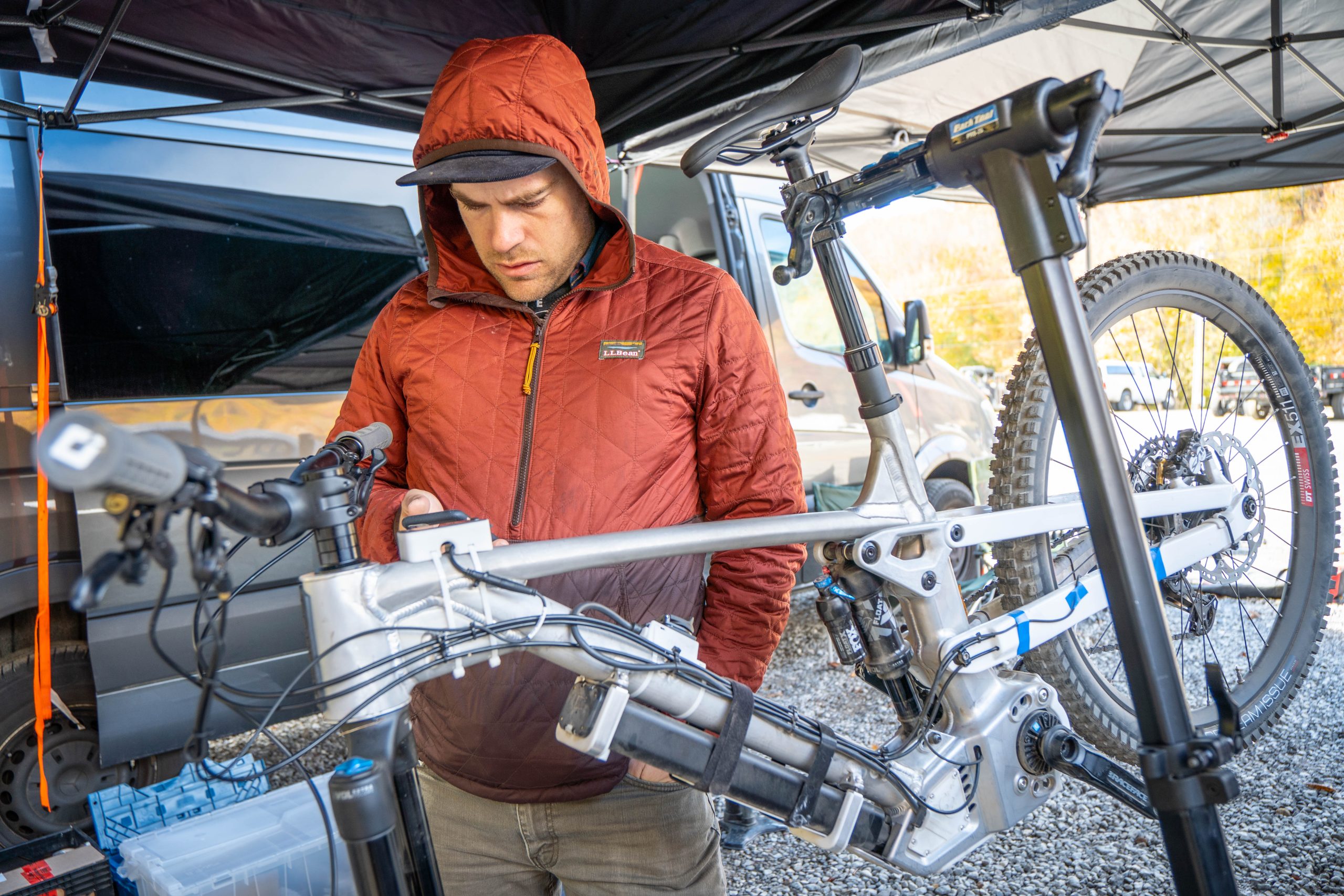
Matt Yerke – Slash (non-ebike) frame engineer
There quite literally isn’t another bike brand on earth that has managed to create and sell an e-Bike version of a regular MTB with identical geometry, travel and rear linkage design, except now for you guys with the Slash and Slash+. Where along the journey did you begin to realise that a ‘challenge’ like that could even be possible to achieve?
Matt: We thought we realized it very early in the process, when we were laying out the hard points (pivot placement, geometry, etc). We didn’t fully understand the problem until we designed the first prototype. That bike actually used the composite rear end from the standard Slash. At this time, we learned that fitting all the features of the standard Slash, like size specific chainstay length, would present additional challenges during Slash+ design.
The ‘high pivot’ Slash was released almost a full year ahead of the Slash+ but given that the 2 models share so many identical features were the pair developed alongside each other right from day one?
That’s right. We designed the bike to be both an eMTB and MTB from day 1. We saw success with the Exe and EX being very close in form and took this bike even further.

This is one of the first e-Bikes on market to feature a high pivot and idler combo incorporated into its design – what are some of the advantages in terms of the ride quality that this configuration offer and ultimately what made you embrace it in both the Slash and Slash+ platforms?
The Slash and Slash+ offer similar advantages with respect to kinematics. High pivot + idler bikes are often touted for their straight-line bump eating capabilities and the Slash platform features these. But something that is less touted is the Slash platform’s ability to climb through bumpy trails with grace. The rider is able to pedal fluidly on bumpy trails and maintain traction. This characteristic really comes through on the Slash+.
What are some of the very first steps in the process when you guys start out on a project like developing a new Slash?
Generally, our bikes start with geometry and kinematics. From there, we move onto making sure that we can fit all the parts on the bike. Fitting a water bottle and a 230mm e2e shock on a size small frame can be a real challenge. From there, we will design a prototype and have that fabricated by our amazing proto shop and move onto ride testing.
In terms of the original design brief are the objectives that the bike needs to have ‘set in stone’ from the beginning, such as the bike must have 170mm of travel, or is the brief more fluid allowing for the bike to evolve throughout its R&D so that you guys can experiment with different things in order to hopefully land on the perfect balance in the end?
An overarching goal of the bike was to increase a rider’s confidence to push their limits on the bike. For some, this means finally trying that 0.5m drop. For others, it means larger features. Larger goals like rider confidence allow us to evolve the bike throughout R&D. We hope goals like these give us a good balance in the end.
From an engineering standpoint what is harder to design/develop, an e-Bike or a regular bike? Despite the obvious factor that an e-Bike requires a lot more pieces of the puzzle, does that automatically make it a lot more challenging?
Oh that’s easy, e-Bikes for sure, no question about it! The newness of e-bikes means both frame designers and e-systems designers are constantly learning what they can do. Also, as you mention, there are a lot more pieces to the puzzle and that does make it more challenging.
 Ross Rushin – Head of Trek’s MTB Global Marketing
[R]: From start to finish, what kind of a time frame did it take for your team to get the Slash+ ready to release onto the market?
About September 2022 is when we first started actively working on this bike (first prototypes) and it launched (bikes in stores) in July 2024.

Kyle Neuser – Industrial designer lead for the Slash+
We asked this same question to Matt Yerke, but we’d also like to hear your take on it: there quite literally isn’t another bike brand on earth that has managed to create and sell an e-Bike version of a regular MTB with identical geometry, travel and rear linkage design, except now for you guys with the Slash and Slash+. Where along the journey did you begin to realise that a ‘challenge’ like that could even be possible to achieve?
That’s a good question, we learned from the EX and EXe where things were very close but not exactly the same and wondered why did that have to be? In addition to both Slash and Slash+ riding very similarly and sharing parts, it also simplifies things on the back end for our manufacturing partners, supply chain, warranty and assembly. We take all this into account when developing new platforms.
You are responsible for delivering the design language of the bike throughout its development. What did that entail for this particular bike?
I was lucky enough to work on the Gen 6 Slash with Matt so transitioning to the Slash+ was seamless as much of the aesthetic development was done on that previous bike. We knew we wanted to share parts that were already developed and working well in the field so we kept the same bolt on lower shock mount, adjustable HS cups, rocker links, chainstay and hardware. We updated our chainstay to be able to route our speed sensor through it, but it looks nearly identical to the Gen6 Slash CS. Much time was spent on packaging the electronic components, routing cables, working through the assembly and user interaction of all the guards and covers. Many prototypes were made to hone in the details and deliver a frame that looks as close as possible to the Gen6 Slash.
You mentioned one of the goals of the Slash+ was to create a bike that breeds confidence, encouraging the rider to push hard and ride like they wouldn’t have thought possible. How are some of ways you’ve ultimately achieved that?
This all started on the Gen6 Slash R&D project and Matt mentioned it as well, the geo and kinematics were focused on creating a ride that pushes you to progress as a rider. Whether you are struggling to overcome some basic trail features or you are trying to get higher on the podium, we saw the Slash as a tool to get you there. Now with e-version of Slash, the motor and battery allow you to tackle those tricky features over and over without tiring as fast. It gets you more laps on that trail or allows you to climb back up that section and repeat it until you’ve met your goal. The TQ HPR-50 is the motor that feels the closest to pedaling a real bike, so the climbing skills you develop on the e-version carry over to your human powered mountain bike.
 Katy Steudel – Lead Design & Graphics on the Slash+
[R]: How would you describe the style guide that you guys ultimately went with for the Slash+?
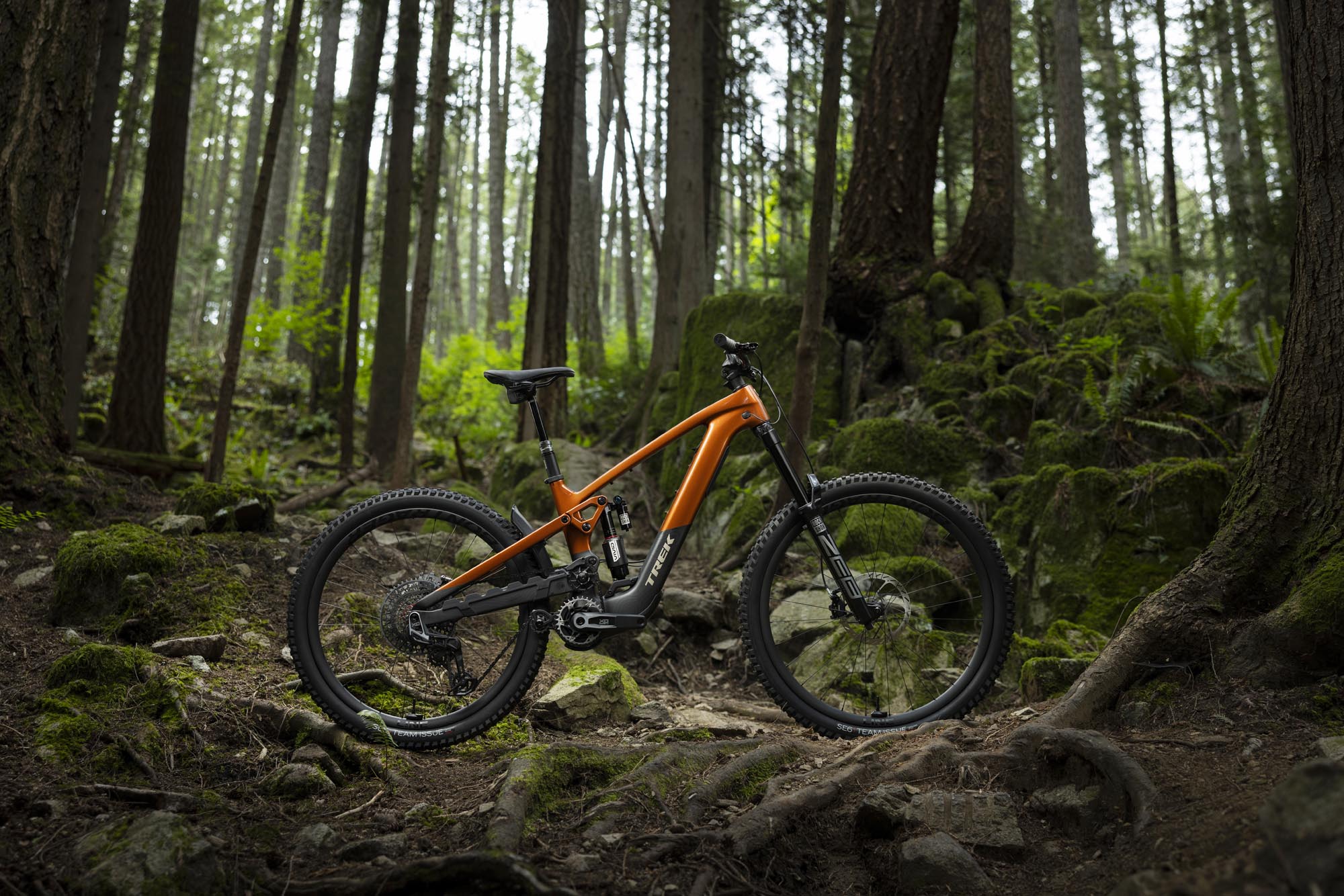
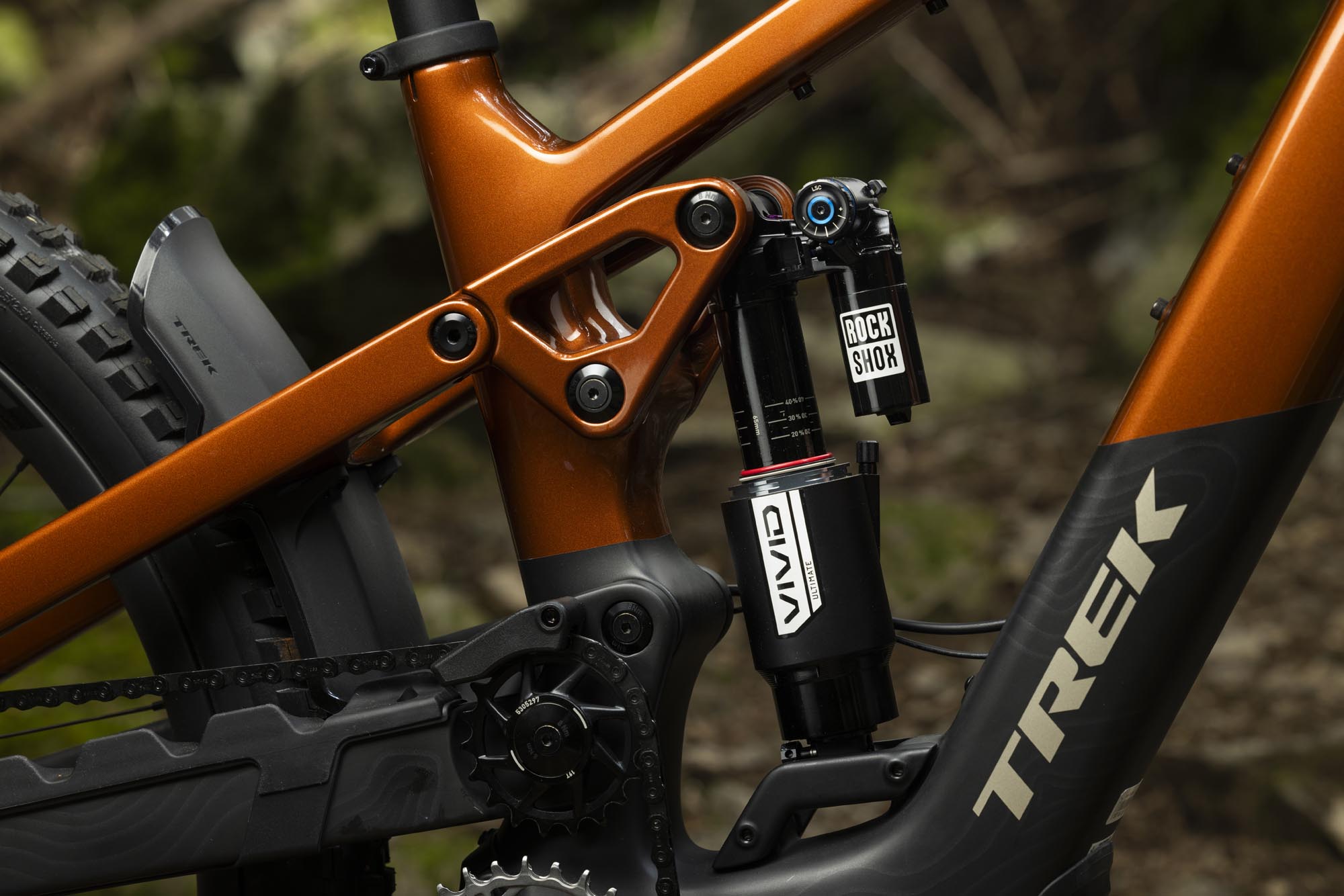
Katy: Bold but not loud – this bike doesn’t need to shout. Many colorways are dark and moody/broody. It’s a handsome bike – I wanted it to look badass so that people feel confident as hell. In general, I want you to think you know what you’re looking at until you get up next to it and notice details. Most colorways are like a high performance engine in a sleeper car. The topographical line effect reveals itself as the metallic catches the light. The bike that looked black is a deep red smoke. The gloss Pennyflake has matte Dark Web masking, which blends with the guards, mimicking the finish. Even the neutral Mercury 9.9, uncomplicated at first glance, uses paint colours that were developed together with the same fine metallic particle and slightly warm tone. The lower masking was designed to visually contain the guards and pulleys. Most colorways have a dark color in the lower masking to make things recede – though though we flip it and pop it on the Red Smoke 9.7 for some variety and to showcase the tech.
[R]: Each colourway throughout the range has a very striking, yet balanced appearance. I particularly dig how you’ve incorporated the geo lines into the lower portion of the frame’s paint finish. Can you tell us a little more about that concept?
Katy: For this project we wanted most colorways to be nicely understated. If a brighter colour is used, like Pennyflake or Crimson, it’s tempered with a darker tone. Highest contrast is reserved for the smallest elements – the logos and tech decals. Topographical lines are well-trodden territory, but we executed them in a fresh way. The 3D effect mimics ripple marks on sand or snow. We worked to make sure the opacity was subtle but looked intentional. The pattern appears in the right lighting from the right angles, and isn’t austentatious.

